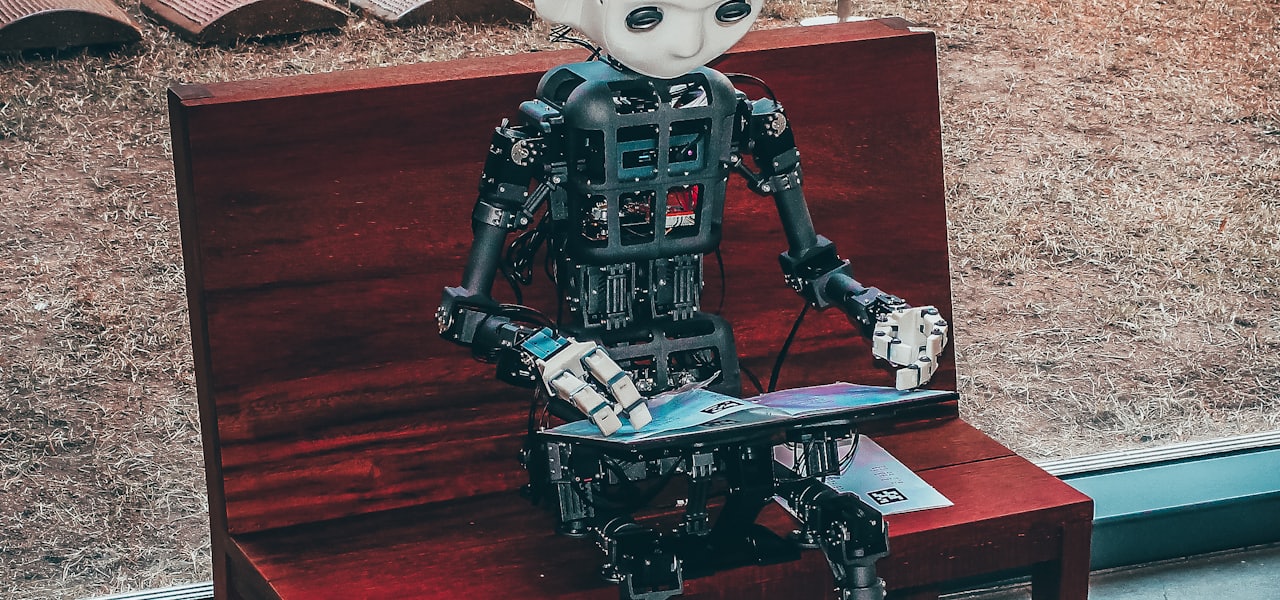
DialogOS is a graphical programming environment to design computer system which can converse through voice with the user. Dialogs are clicked together in a Flowchart. DialogOS includes bindings to control Lego Mindstorms robots by voice and has bindings to SQL databases, as well as a generic plugin architecture to integrate with other types of backends. DialogOS is used in computer science courses in schools and universities to teach programming and to introduce beginners in the basic principles of human/computer interaction and dialog design. It has also been used in research systems. DialogOS was initially developed commercially by CLT Sprachtechnologie GmbH until its liquidation in 2017. The rights were then acquired by Saarland University and the software was released as open-source. == Bindings to Lego Mindstorms NXT == DialogOS can control the LEGO Mindstorms NXT Series. It uses sensor-nodes to obtain values for the following sensors: noise sensor ultrasonic sensor touch sensor luminosity sensor
Representation collapse
Representation collapse is a phenomenon in machine learning and representation learning where a model maps different inputs to the same or very similar embeddings, which means it loses important information about how the data is spread out. It is frequently encountered in self-supervised learning, especially within contrastive and non-contrastive frameworks, when training objectives or model architectures do not maintain variance across representations. Collapse results in degenerate solutions characterized by uninformative learned features, significantly impairing downstream task performance. Various techniques have been proposed to mitigate representation collapse, including the use of negative samples, architectural asymmetry, stop-gradient operations, variance regularization, and redundancy reduction objectives, as seen in methods such as SimCLR, BYOL, and VICReg. Comprehending and averting representation collapse is regarded as a fundamental challenge in the advancement of stable and efficient self-supervised learning systems.
Kruti
Kruti is a multilingual AI agent and chatbot developed by the Indian company Ola Krutrim. It is designed to perform real-world tasks for users, such as booking taxis and ordering food, by integrating directly with various online services. It is notable for its ability to understand and respond in multiple Indian languages. Developed by a team founded by Bhavish Aggarwal, Kruti functions as an "agentic" AI, meaning it can reason, plan, and execute multi-step tasks to fulfill a user's request. The backend technology combines several open-source large language models with Ola's proprietary Krutrim V2 model. The system was developed to work primarily on smartphones, addressing the Indian market's specific needs, including language diversity and potential bandwidth constraints. Kruti was officially released in June 2025, replacing an earlier chatbot from the company that was also named Krutrim. Initially supporting 13 languages, the company plans to expand its capabilities to 22 Indian languages. == Background == Kruti is an improved version of Ola's Krutrim chatbot, which was first launched in 2023 and was intended to be replaced by Kruti. It was officially released on 12 June 2025 as an upgrade to passive chatbots, with support for text and voice in 13 Indian languages. As an agentic AI, it can execute tasks with customization and reasoning, providing adaptive answers based on user preferences and past interactions. Kruti is optimized for smartphone usage and designed to accommodate bandwidth constraints and usage patterns in India. To ensure scalability and cost-effective performance, it combines various open-source large language models with Ola's own Krutrim V2, which has 12 billion parameters. Its speech recognition is built to identify regional Indian languages, dialects, and accents. Due to its integration with numerous apps and services, Kruti is context-aware and can proactively complete tasks. Initially connected only with Ola ecosystem services, Krutrim intends to expand and incorporate various Indian services into Kruti, with the goal of adding services from Blinkit, Swiggy, and Uber with respective voice command support. On 20 June 2025, Krutrim acquired the AI platform BharatSah‘AI’yak to increase its involvement in government, education, and agriculture projects. This acquisition will allow Kruti to assist in broadening the scope of BharatSah'AI'yak's work on India-centric, vernacular retrieval-augmented generation AI bots. == Development == Kruti is designed to perform tasks with minimal user input, accepting documents, images, and text, without requiring users to switch between applications. Its agentic framework breaks queries into sub-tasks executed by multiple agents working sequentially or concurrently, with reported accuracy exceeding 90%. Kruti connects to company databases and APIs via the Model Context Protocol and presents responses as summaries, tables, or narratives adapted to user behaviour. The system supports payments via credit/debit cards and UPI. The underlying stack, which includes foundation models and AI training and inference systems, is intended to support adaptation across sectors such as healthcare, education, and finance. Ola Cabs and the Open Network for Digital Commerce have begun integrating Kruti into their platforms pending broader reliability testing.
Trigram
Trigrams are a special case of the n-gram, where n is 3. They are often used in natural language processing for performing statistical analysis of texts and in cryptography for control and use of ciphers and codes. See results of analysis of "Letter Frequencies in the English Language". == Frequency == Context is very important, varying analysis rankings and percentages are easily derived by drawing from different sample sizes, different authors; or different document types: poetry, science-fiction, technology documentation; and writing levels: stories for children versus adults, military orders, and recipes. Typical cryptanalytic frequency analysis finds that the 16 most common character-level trigrams in English are: Because encrypted messages sent by telegraph often omit punctuation and spaces, cryptographic frequency analysis of such messages includes trigrams that straddle word boundaries. This causes trigrams such as "edt" to occur frequently, even though it may never occur in any one word of those messages. == Examples == The sentence "the quick red fox jumps over the lazy brown dog" has the following word-level trigrams: the quick red quick red fox red fox jumps fox jumps over jumps over the over the lazy the lazy brown lazy brown dog And the word-level trigram "the quick red" has the following character-level trigrams (where an underscore "_" marks a space): the he_ e_q _qu qui uic ick ck_ k_r _re red
Eigenmoments
EigenMoments is a set of orthogonal, noise robust, invariant to rotation, scaling and translation and distribution sensitive moments. Their application can be found in signal processing and computer vision as descriptors of the signal or image. The descriptors can later be used for classification purposes. It is obtained by performing orthogonalization, via eigen analysis on geometric moments. == Framework summary == EigenMoments are computed by performing eigen analysis on the moment space of an image by maximizing signal-to-noise ratio in the feature space in form of Rayleigh quotient. This approach has several benefits in Image processing applications: Dependency of moments in the moment space on the distribution of the images being transformed, ensures decorrelation of the final feature space after eigen analysis on the moment space. The ability of EigenMoments to take into account distribution of the image makes it more versatile and adaptable for different genres. Generated moment kernels are orthogonal and therefore analysis on the moment space becomes easier. Transformation with orthogonal moment kernels into moment space is analogous to projection of the image onto a number of orthogonal axes. Nosiy components can be removed. This makes EigenMoments robust for classification applications. Optimal information compaction can be obtained and therefore a few number of moments are needed to characterize the images. == Problem formulation == Assume that a signal vector s ∈ R n {\displaystyle s\in {\mathcal {R}}^{n}} is taken from a certain distribution having correlation C ∈ R n × n {\displaystyle C\in {\mathcal {R}}^{n\times n}} , i.e. C = E [ s s T ] {\displaystyle C=E[ss^{T}]} where E[.] denotes expected value. Dimension of signal space, n, is often too large to be useful for practical application such as pattern classification, we need to transform the signal space into a space with lower dimensionality. This is performed by a two-step linear transformation: q = W T X T s , {\displaystyle q=W^{T}X^{T}s,} where q = [ q 1 , . . . , q n ] T ∈ R k {\displaystyle q=[q_{1},...,q_{n}]^{T}\in {\mathcal {R}}^{k}} is the transformed signal, X = [ x 1 , . . . , x n ] T ∈ R n × m {\displaystyle X=[x_{1},...,x_{n}]^{T}\in {\mathcal {R}}^{n\times m}} a fixed transformation matrix which transforms the signal into the moment space, and W = [ w 1 , . . . , w n ] T ∈ R m × k {\displaystyle W=[w_{1},...,w_{n}]^{T}\in {\mathcal {R}}^{m\times k}} the transformation matrix which we are going to determine by maximizing the SNR of the feature space resided by q {\displaystyle q} . For the case of Geometric Moments, X would be the monomials. If m = k = n {\displaystyle m=k=n} , a full rank transformation would result, however usually we have m ≤ n {\displaystyle m\leq n} and k ≤ m {\displaystyle k\leq m} . This is specially the case when n {\displaystyle n} is of high dimensions. Finding W {\displaystyle W} that maximizes the SNR of the feature space: S N R t r a n s f o r m = w T X T C X w w T X T N X w , {\displaystyle SNR_{transform}={\frac {w^{T}X^{T}CXw}{w^{T}X^{T}NXw}},} where N is the correlation matrix of the noise signal. The problem can thus be formulated as w 1 , . . . , w k = a r g m a x w w T X T C X w w T X T N X w {\displaystyle {w_{1},...,w_{k}}=argmax_{w}{\frac {w^{T}X^{T}CXw}{w^{T}X^{T}NXw}}} subject to constraints: w i T X T N X w j = δ i j , {\displaystyle w_{i}^{T}X^{T}NXw_{j}=\delta _{ij},} where δ i j {\displaystyle \delta _{ij}} is the Kronecker delta. It can be observed that this maximization is Rayleigh quotient by letting A = X T C X {\displaystyle A=X^{T}CX} and B = X T N X {\displaystyle B=X^{T}NX} and therefore can be written as: w 1 , . . . , w k = a r g m a x x w T A w w T B w {\displaystyle {w_{1},...,w_{k}}={\underset {x}{\operatorname {arg\,max} }}{\frac {w^{T}Aw}{w^{T}Bw}}} , w i T B w j = δ i j {\displaystyle w_{i}^{T}Bw_{j}=\delta _{ij}} === Rayleigh quotient === Optimization of Rayleigh quotient has the form: max w R ( w ) = max w w T A w w T B w {\displaystyle \max _{w}R(w)=\max _{w}{\frac {w^{T}Aw}{w^{T}Bw}}} and A {\displaystyle A} and B {\displaystyle B} , both are symmetric and B {\displaystyle B} is positive definite and therefore invertible. Scaling w {\displaystyle w} does not change the value of the object function and hence and additional scalar constraint w T B w = 1 {\displaystyle w^{T}Bw=1} can be imposed on w {\displaystyle w} and no solution would be lost when the objective function is optimized. This constraint optimization problem can be solved using Lagrangian multiplier: max w w T A w {\displaystyle \max _{w}{w^{T}Aw}} subject to w T B w = 1 {\displaystyle {w^{T}Bw}=1} max w L ( w ) = max w ( w T A w − λ w T B w ) {\displaystyle \max _{w}{\mathcal {L}}(w)=\max _{w}(w{T}Aw-\lambda w^{T}Bw)} equating first derivative to zero and we will have: A w = λ B w {\displaystyle Aw=\lambda Bw} which is an instance of Generalized Eigenvalue Problem (GEP). The GEP has the form: A w = λ B w {\displaystyle Aw=\lambda Bw} for any pair ( w , λ ) {\displaystyle (w,\lambda )} that is a solution to above equation, w {\displaystyle w} is called a generalized eigenvector and λ {\displaystyle \lambda } is called a generalized eigenvalue. Finding w {\displaystyle w} and λ {\displaystyle \lambda } that satisfies this equations would produce the result which optimizes Rayleigh quotient. One way of maximizing Rayleigh quotient is through solving the Generalized Eigen Problem. Dimension reduction can be performed by simply choosing the first components w i {\displaystyle w_{i}} , i = 1 , . . . , k {\displaystyle i=1,...,k} , with the highest values for R ( w ) {\displaystyle R(w)} out of the m {\displaystyle m} components, and discard the rest. Interpretation of this transformation is rotating and scaling the moment space, transforming it into a feature space with maximized SNR and therefore, the first k {\displaystyle k} components are the components with highest k {\displaystyle k} SNR values. The other method to look at this solution is to use the concept of simultaneous diagonalization instead of Generalized Eigen Problem. === Simultaneous diagonalization === Let A = X T C X {\displaystyle A=X^{T}CX} and B = X T N X {\displaystyle B=X^{T}NX} as mentioned earlier. We can write W {\displaystyle W} as two separate transformation matrices: W = W 1 W 2 . {\displaystyle W=W_{1}W_{2}.} W 1 {\displaystyle W_{1}} can be found by first diagonalize B: P T B P = D B {\displaystyle P^{T}BP=D_{B}} . Where D B {\displaystyle D_{B}} is a diagonal matrix sorted in increasing order. Since B {\displaystyle B} is positive definite, thus D B > 0 {\displaystyle D_{B}>0} . We can discard those eigenvalues that large and retain those close to 0, since this means the energy of the noise is close to 0 in this space, at this stage it is also possible to discard those eigenvectors that have large eigenvalues. Let P ^ {\displaystyle {\hat {P}}} be the first k {\displaystyle k} columns of P {\displaystyle P} , now P T ^ B P ^ = D B ^ {\displaystyle {\hat {P^{T}}}B{\hat {P}}={\hat {D_{B}}}} where D B ^ {\displaystyle {\hat {D_{B}}}} is the k × k {\displaystyle k\times k} principal submatrix of D B {\displaystyle D_{B}} . Let W 1 = P ^ D B ^ − 1 / 2 {\displaystyle W_{1}={\hat {P}}{\hat {D_{B}}}^{-1/2}} and hence: W 1 T B W 1 = ( P ^ D B ^ − 1 / 2 ) T B ( P ^ D B ^ − 1 / 2 ) = I {\displaystyle W_{1}^{T}BW_{1}=({\hat {P}}{\hat {D_{B}}}^{-1/2})^{T}B({\hat {P}}{\hat {D_{B}}}^{-1/2})=I} . W 1 {\displaystyle W_{1}} whiten B {\displaystyle B} and reduces the dimensionality from m {\displaystyle m} to k {\displaystyle k} . The transformed space resided by q ′ = W 1 T X T s {\displaystyle q'=W_{1}^{T}X^{T}s} is called the noise space. Then, we diagonalize W 1 T A W 1 {\displaystyle W_{1}^{T}AW_{1}} : W 2 T W 1 T A W 1 W 2 = D A {\displaystyle W_{2}^{T}W_{1}^{T}AW_{1}W_{2}=D_{A}} , where W 2 T W 2 = I {\displaystyle W_{2}^{T}W_{2}=I} . D A {\displaystyle D_{A}} is the matrix with eigenvalues of W 1 T A W 1 {\displaystyle W_{1}^{T}AW_{1}} on its diagonal. We may retain all the eigenvalues and their corresponding eigenvectors since most of the noise are already discarded in previous step. Finally the transformation is given by: W = W 1 W 2 {\displaystyle W=W_{1}W_{2}} where W {\displaystyle W} diagonalizes both the numerator and denominator of the SNR, W T A W = D A {\displaystyle W^{T}AW=D_{A}} , W T B W = I {\displaystyle W^{T}BW=I} and the transformation of signal s {\displaystyle s} is defined as q = W T X T s = W 2 T W 1 T X T s {\displaystyle q=W^{T}X^{T}s=W_{2}^{T}W_{1}^{T}X^{T}s} . === Information loss === To find the information loss when we discard some of the eigenvalues and eigenvectors we can perform following analysis: η = 1 − t r a c e ( W 1 T A W 1 ) t r a c e ( D B − 1 / 2 P T A P D B − 1 / 2 ) = 1 − t r a c e ( D B ^ − 1 / 2 P ^ T A P ^ D B ^ − 1 / 2 ) t r a c e ( D B − 1 / 2 P T A P D B − 1 / 2 ) {\displaystyle {\begin{array}{lll}\eta &=&
Edits (app)
Edits is an American photo and short form video editing software service owned by Meta Platforms. It allows users to create videos and edit them by using features like green screens, and AI animation, and also provides real-time statistics to Instagram creators to track their accounts. Accounts directly from Instagram can be imported, and videos can be exported vice-versa. It is available solely on iOS and Android. On Apple, it supports over 32 different languages, including French, Spanish, and Chinese. It has been noted by critics as a direct competitor for apps like CapCut, owned by Chinese brand ByteDance. The Instagram head, Adam Mosseri, also acknowledged these similarities. Launched on April 22 for both iOS and Android. It received over 5M+ users on Apple and Android combined in its first 4 days since its launch. == History == On January 19, 2025, following the ban of all ByteDance Apps from the Google Play Store, and App Store, Instagram head Adam Mosseri announced on Threads that they would be launching the app in February for iOS, followed by an Android counterpart. He said the app is working with select people to test its features. In a separate post, he emphasized that the app is "more for creators than casual video makers". == Features == Edits contains many similar features to other competition of video editors like KineMaster, Inshot, and CapCut. When creating a video, users have the option to export in resolution of HD, 4K, and 2K, along with having HDR and SDR support. Like many traditional video editing software, it includes a timeline, and basic undo-redo buttons. On the bottom bar, 7 tabs for editing exist, namely the Split, Volume, Adjust, Speed, Delete, Filters, Green Screen, Voice FX, Extract Audio, Mirror, Slip, Replace and Duplicate bars. Basic features, like splitting, and adjusting speed and volume of clips are present, along with more advanced Green Screens, and AI features. Being a mobile video editor app, Edits also has drag-and-drop features to ease customer usage. Users have the ability to record videos directly within the app. This feature allows users to create content without needing extra software or devices. They can choose from several focal lengths, which affect how close or wide the shot appears. The app also supports different frame rates. Users have the ability to record videos directly within the app. This feature allows users to create content without needing extra software or devices. Once users are done filming your clips, they can simply transfer them into a project to start editing immediately. Upcoming features for the app include Keyframes, AI-powered modification, Collaboration, and Enhanced creativity. == Reception == Since its release, it received over 5 million downloads in 4 days. Critically, the app received great rankings from many. From users, the app received an average of 4.45 stars over Google Play Store and App Store in the first few days, with Google Play Store receiving the least stars. As in reviews, it was received mixed by the public. Many people praised the smoothness and intuivity of the app. "The app is more than just a basic editor, offering a full suite of creative tools, including a dedicated tab for inspiration and trending audio, as well as a tab for managing drafts," said a blogger. Some users were disappointed with the range of editing tools, some users have noted that it could benefit from more transition options between clips. Some even reported crashing between clips.
Night Sky (app)
Night Sky (app) is an application developed and published by indie studio iCandi Apps Ltd. from the UK. Night Sky is a stargazing reference app, where the user can explore a virtual representation of the night sky to identify stars, planets, constellations and satellites. The app is developed specifically for iOS, tvOS and watchOS devices. Night Sky was first released on November 1, 2011 for iOS, and has had multiple updates since launch. Night Sky was mentioned in the September 2016 Apple Keynote during the Apple Watch Series 2 announcement. In October 2016, Night Sky was featured as the Free App of The Week on the Apple App Store. == Reception == Night Sky was featured in Apple's 'Best of 2012' and has also been pre-installed onto iPads in Apple retail stores worldwide.